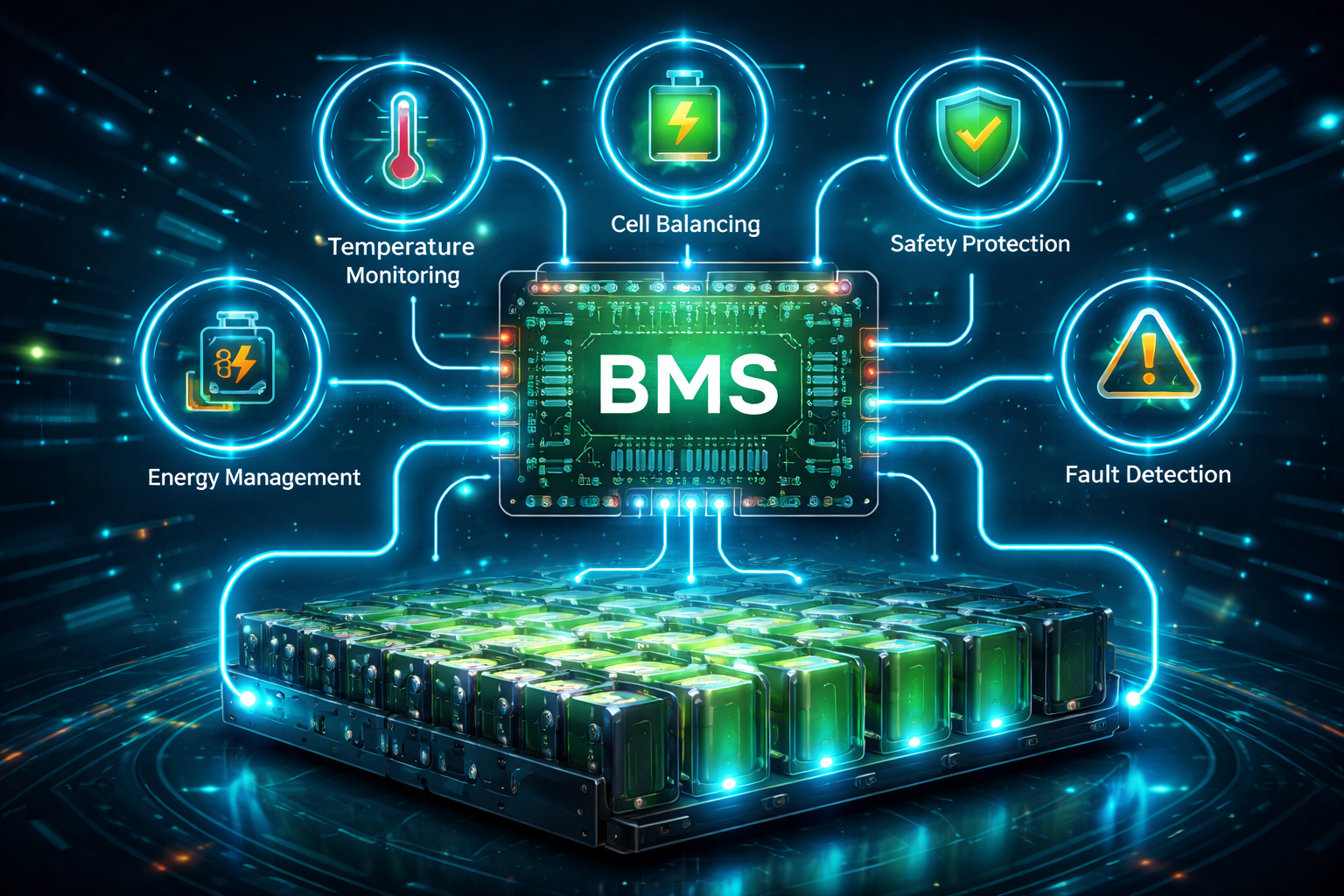
BMS Functions

A practical guide to Battery Management System functions

How BMS protects storage assets and enables safe, reliable microgrid operation.

  • Controller optimizes the microgrid.
  • BMS protects the battery.
  • Both must be aligned for safety, availability, and lifecycle value.

Why the BMS Matters

Batteries are sensitive electrochemical systems. Without proper monitoring and control, a BESS can experience:

  • Accelerated degradation and reduced usable capacity
  • Unexpected shutdowns or lockouts during critical events
  • Thermal stress and unsafe operating conditions
  • Cell imbalance leading to performance loss
  • Safety incidents due to overvoltage, undervoltage, or overheating

The BMS prevents these outcomes by continuously monitoring battery conditions and enforcing safe limits in real time.

âś… The controller optimizes the microgrid.

âś… The BMS protects the battery.

Both are essential—and must be aligned.

Core BMS Functions

A modern BMS performs several core functions that support safe and reliable energy storage operation:

1

Cell Monitoring (Voltage, Current, Temperature)

The BMS monitors battery health at the most granular level—often down to individual cells or cell groups.

  • Cell voltage
  • Pack voltage
  • Current (charge/discharge)
  • Temperature (cell/module/pack)

Real-time data is used to detect abnormal conditions early and prevent unsafe operation.

2

State of Charge (SOC) Estimation

SOC indicates how much usable energy remains in the battery. Because SOC cannot be directly measured, the BMS estimates SOC using:

  • Voltage behavior
  • Coulomb counting
  • Temperature compensation
  • Model-based estimation algorithms

Accurate SOC supports outage reserves, prevents overcharge/over-discharge, and improves EMS dispatch decisions.

3

State of Health (SOH) Tracking

SOH represents battery condition over time—how much the battery has aged and how much capacity is still available.

  • Forecast performance degradation
  • Plan maintenance and replacement
  • Verify warranty compliance
  • Avoid over-committing dispatch logic
4

Protection Functions (Safety Limits Enforcement)

A primary role of the BMS is to prevent unsafe electrical and thermal operation by enforcing limits such as:

  • Overvoltage / undervoltage protection
  • Overcurrent protection (charge/discharge)
  • Overtemperature / undertemperature protection
  • Short-circuit detection
  • Insulation monitoring (architecture dependent)

When thresholds are exceeded, the BMS may derate power, command inverter shutdown, isolate modules, or trigger alarms/ESD.

5

Cell Balancing

Over time, cells drift and become unbalanced due to variation, cycling, and temperature differences. Unbalanced cells reduce usable capacity and can create safety risks.

  • Equalize cell voltages
  • Maximize usable capacity
  • Reduce degradation risk
  • Improve long-term stability

Balancing can be passive or active depending on system design.

6

Thermal Management Coordination

Battery performance and safety are strongly dependent on temperature. The BMS supports thermal management by:

  • Monitoring temperature gradients
  • Coordinating cooling/heating systems
  • Limiting power at unsafe temperatures
  • Preventing operation outside thermal ranges

Essential for microgrids in high heat, cold climates, indoor enclosures, or tight footprints.

7

Fault Detection, Diagnostics & Event Logging

A strong BMS supports troubleshooting and compliance through:

  • Fault detection and classification
  • Alarm generation and prioritization
  • Event logs for incident analysis
  • Trending of cell behavior over time

Improves safety, maintainability, and long-term reliability.

8

Communications & System Integration

BMS data must integrate with higher-level systems such as inverter controls, microgrid controllers (MGC), EMS, and SCADA.

  • SOC, SOH, temperature, voltage reporting
  • Alarms and fault flags
  • Power limits & availability status
  • Operating state & readiness indicators

A microgrid controller should never dispatch the BESS without understanding BMS constraints.

⚠️

Common BMS-Related Design Pitfalls

Frequent issues include:

  • Assuming BMS data is always accurate without calibration validation
  • Dispatching battery power beyond thermal limits
  • Inadequate SOC reserve planning for resilience use cases
  • Lack of clear alarm mapping into SCADA
  • Poor integration between BMS limits and EMS dispatch targets
  • Missing documentation on shutdown thresholds and reset conditions
  • Failure to test degraded/fault conditions during commissioning
These issues often cause unexpected shutdowns—especially during critical events.

BMS • Testing • Safety

Validation Requirements

BMS functions and behavior are system-specific and must be validated through testing.

This page provides general educational guidance only. Final BMS integration must be confirmed through:

  • âś… Vendor technical review and configuration validation
  • âś… FAT/SAT testing and alarm verification
  • âś… Thermal performance testing (where required)
  • âś… Operating mode scenario testing
  • âś… Safety compliance review and documentation
  • âś… Coordination with inverter, EMS, and microgrid controller logic
All energy storage safety systems should be designed and reviewed by qualified professionals.